Academic Calendar
The VBCCM Academic Calendar describes the basic curriculum for Acupuncturist, Herblist, TCM practioner and Dr. TCM programs. Traditional Chinese Medicine practitioner. Please contact us if you would like a copy of our Academic Calendar.
|

|
Students
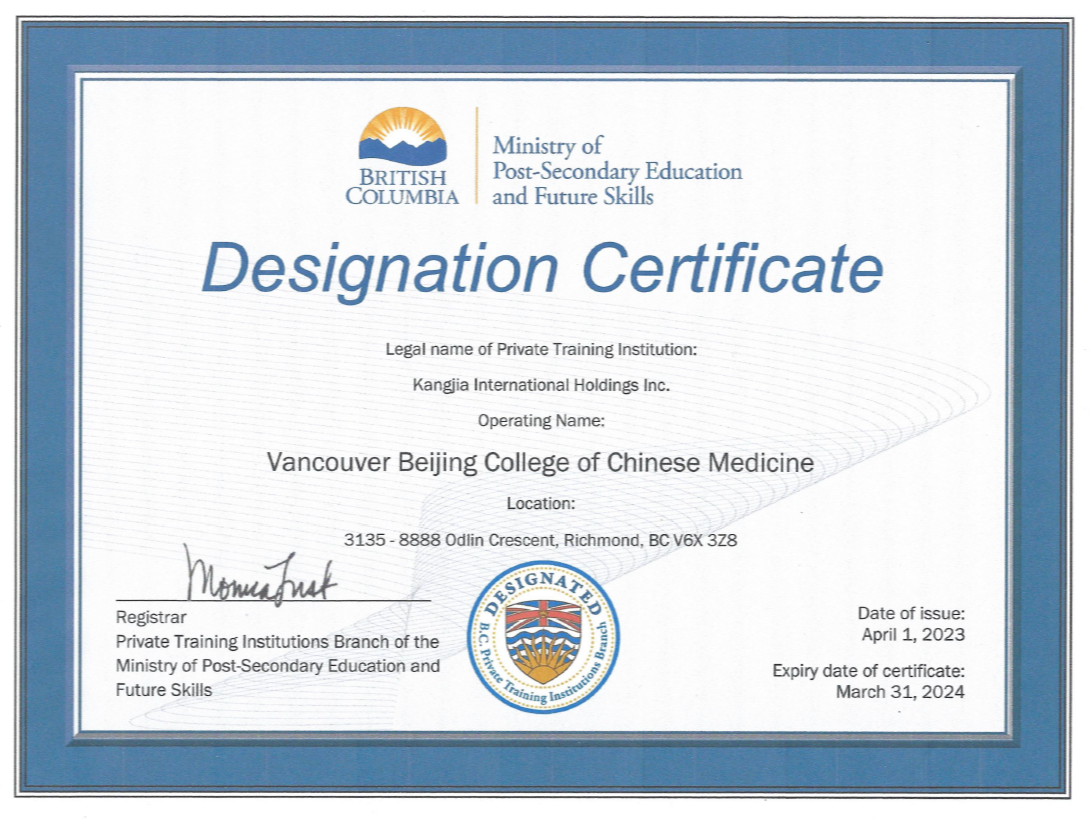
Students benefit from our personalized training with individual attention and many hours of clinical supervision and practice. We provide intensive hands-on training in our student clinic which is open to the public also. Upon successful graduation students receive a diploma from our college recognized by BC and some provinces.
|
Curriculum
VBCCM's curriculum offers a wide variety of programs from a Chinese perspective, teaching all aspects of Traditional Chinese Medicine including: Acupuncture, Moxibustion, Herbology, Tui Na, and Qi Gong. Classes in Traditional Chinese Medicine are taught both in Canada and in China by highly regarded Doctors of Traditional Chinese Medicine.
|
Certificate Program
Tuina (Tui Na) is an Oriental Bodywork Therapy that has been used in China for 2,000 years. Tuina (Tui Na) uses the traditional Chinese medical theory of the flow of Qi through the meridians as its basic therapeutic orientation. Through the application of massage and manipulation techniques Tuina (Tui Na) seeks to establish a more harmonious flow of Qi through the system of channels and collaterals, allowing the body the naturally heal itself.
|